Forex trading for beginners versus chasing indicators and why understanding market structure beats geometric patterns
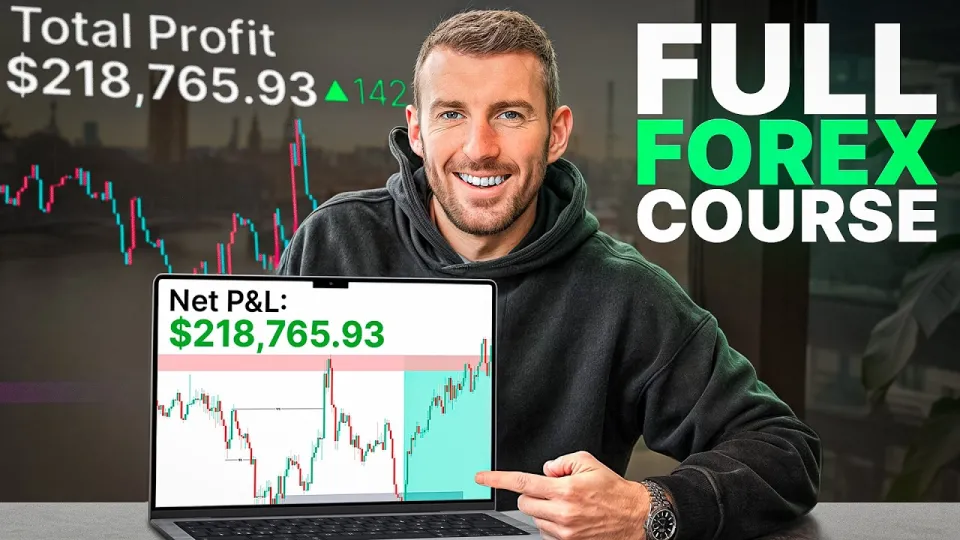
Video: Beginners Guide To Forex Trading In 2026 (+3 hours)
Need articles like this for your video? They help promote it on YouTube and Google — order them in the Telegram bot @sat_sit_bot. The bot writes and publishes the articles itself (with your YouTube video embedded) on popular topical websites (no ads). Your first 50 articles are free.
· based on the channel Matt Donlevey - Photon Trading
Key takeaways
- Forex is an over-the-counter market where currencies are quoted in pairs and the spread, not a commission, is often the main cost.
- Price moves because of order flow and liquidity, not because a triangle or head-and-shoulders pattern says so.
- Matt Donlevey's Photon Trading guide is a free three-hour beginner course covering microstructure, supply and demand, entries, risk and psychology.
- A complete beginner plan needs four parts: a written strategy, backtesting, money management and a trade journal.
- Most beginner losses trace to oversized risk, no trade plan and switching strategies before any of them is tested.
Forex trading for beginners works best when you learn how the market actually moves before you learn patterns: understand bid, ask, spread, order flow and liquidity, then build one rule-based strategy, test it on historical data and control risk per trade. That is the core message of Matt Donlevey's three-hour beginner guide from Photon Trading, and the free course plus cheatsheets that accompany it are available at the Photon Trading free training page.
What forex trading actually is and who is on the other side
Forex is the market where national currencies are exchanged in pairs, and it is decentralised: there is no single exchange, only a network of banks, brokers and liquidity providers quoting prices around the clock on weekdays. When you buy EUR/USD you are simultaneously buying euros and selling dollars, and your profit depends only on the change in the exchange rate between the two.
The counterparties are not other retail traders sitting at laptops. Banks, hedge funds, corporates hedging export revenue and market makers dominate volume, and retail orders are typically routed through a broker that either passes them to a liquidity provider or takes the other side itself. This matters because it explains why price reacts to areas where large orders sit, not to shapes drawn on a chart.
There is also the question of whose money you trade. A retail beginner trades their own capital, but the industry also offers prop-firm funding, where a trader passes an evaluation and then manages the firm's capital under a profit split. Both routes require the same skill: a repeatable process with defined risk.
Why technical analysis alone fails and what replaces it
Technical analysis gets a bad reputation for a fair reason: geometric shapes do not explain why price moves, so a pattern without a mechanism behind it is just a drawing. Two identical triangles can produce opposite outcomes because the orders behind them are different.
The alternative is to study market dynamics: auction market theory, order flow and market microstructure. In practice this means asking where buyers and sellers were forced to transact, where stop losses cluster, and whether the current price is expensive or cheap relative to a recent range. Candlesticks matter, but as a record of where the auction was rejected or accepted, not as a magic signal.
The building blocks of a workable forex framework
A workable framework rests on a handful of concepts that stack on top of each other, and each one answers a different question.
- Market structure. Identify whether the market is trending up, trending down or ranging by tracking swing highs and swing lows. Structure gives you direction, and direction filters out most bad trades.
- Premium and discount. Within a range, the upper half is expensive and the lower half is cheap. Buying in discount and selling in premium improves the reward-to-risk of every entry.
- Multi-timeframe analysis. Use a higher timeframe for bias and a lower one for execution, so the entry is a precise version of a larger idea rather than a random poke.
- Supply and demand. Mark zones where price left rapidly because of an imbalance in orders, then wait for a return to those zones instead of chasing.
- Liquidity. Recognise where stop losses and pending orders sit above highs and below lows, because price often reaches for that liquidity before reversing.
Put together, these give a reason for a trade: bias from structure, location from premium and discount, timing from liquidity and supply and demand, and invalidation from a clear level where the idea is wrong.
Entries, trade management and money management in practice
An entry is only worth taking when the stop loss is defined before the position is opened, and trade management should be decided in advance rather than improvised. Typical decisions include whether to move the stop to break-even, whether to take partial profit at a first target and whether to hold a runner for a larger move. Each choice changes the expectancy of the strategy, so it belongs in the written rules.
Money management is where beginners lose the most. Risking a fixed small percentage of the account per trade, commonly 0.5% to 1%, keeps a losing streak survivable; risking 10% means a run of five losses removes roughly 40% of the account and requires a 67% gain just to recover. Position size follows from the distance to the stop loss, not from how confident you feel.
Costs, brokers and execution details that quietly eat returns
The spread is the difference between the bid and the ask, and it is a cost paid on every trade; a commission-based account can be cheaper for frequent trading, while a wider spread hurts scalpers. Beyond that, check swap or rollover charges on positions held overnight, slippage during news releases, and whether the broker is regulated in a reputable jurisdiction.
Execution matters too: know the difference between market and limit orders, understand that the price you see is the last traded price rather than a guarantee, and test order placement on a demo account before risking real money. A broker with tight spreads but unreliable fills is worse than a slightly more expensive one that executes cleanly.
Backtesting, journaling and the psychology of sticking to one plan
A strategy becomes real only after it has been tested on historical data with a fixed set of rules and a record of every hypothetical trade. Backtesting shows whether the edge exists; journaling shows whether you actually follow it. A trade journal should capture the setup, the reason for entry, the result and the emotional state, because the pattern of deviations is usually more expensive than the strategy itself.
Psychology is easier once the process is mechanical. Traders who have not yet built an edge often blame discipline when the real problem is an untested method, and traders with an edge fail when they abandon it after three losses. Write a trade plan that states the markets, sessions, setups, risk per trade and maximum daily loss, then review the journal weekly.
Common beginner questions and doubts
Many viewers of the guide ask whether a three-hour course can really replace paid material, and the honest answer is that it replaces the scattered tutorial-hopping, not the screen time. The concepts, from microstructure to a full strategy, are covered in one sequence, but applying them still takes weeks of chart practice and backtesting.
The most frequent doubts concern speed and language: some learners find the delivery fast and hard to follow in a second language, so slowing playback and pausing at each concept is a legitimate approach. Others ask whether trading psychology should come first, and the more practical order is to build and test a strategy, then work on discipline once there is something to be disciplined about.
A third recurring question is about starting capital. Small accounts are not a barrier to learning, but they are a barrier to income: with 1% risk, a $1,000 account risks $10 per trade, so the goal at that stage is a clean process and a growing sample of journaled trades, not a salary.
Useful links
- Free Photon Trading course and cheatsheets: https://www.photontradingfx.com/free-training?el=beginnersguide&htrafficsource=YT
- Photon Trading mentorship: https://www.photontradingfx.com?el=beginnersguide&htrafficsource=yt
- Free Telegram channel with analysis and trade recaps: https://t.me/photontrading
- Instagram: https://www.instagram.com/photontrading/
Final thoughts on learning forex the systematic way
Forex rewards a process, not a prediction: understand order flow and liquidity, pick one framework, define risk before entry, and let a journal tell you whether the edge is real. The three-hour beginner guide from the channel Matt Donlevey - Photon Trading is a structured starting point that covers microstructure, market structure, supply and demand, entries, money management and psychology in a single sequence. Start with the free Photon Trading course and cheatsheets, then commit to backtesting and journaling for at least a few months before increasing risk.
Source: Beginners Guide To Forex Trading In 2026 (+3 hours) · Markdown version
Questions & answers
Can a free three-hour course really teach forex trading?
It can teach the framework: what the market is, how spreads and order flow work, how to read structure and where to place entries and stops. What it cannot compress is practice, so expect weeks of chart time and backtesting before the rules feel natural.
Should I work on trading psychology before or after building a strategy?
Build and test the strategy first, then work on psychology. Discipline only pays off when there is a tested edge to be disciplined about; otherwise a calm trader still loses money with a method that has no expectancy.
How much capital do I need to start trading forex?
You can start with a small account, but position sizing decides the outcome. At 1% risk a $1,000 account risks $10 per trade, which is enough to practise a process but not to generate income, so treat early trading as skill-building.
Why do so many beginners fail with technical analysis?
Because patterns describe shapes without explaining the orders behind them. Two identical setups can resolve differently depending on where liquidity and resting orders sit, so structure, supply and demand and order flow give context that a chart pattern alone does not.